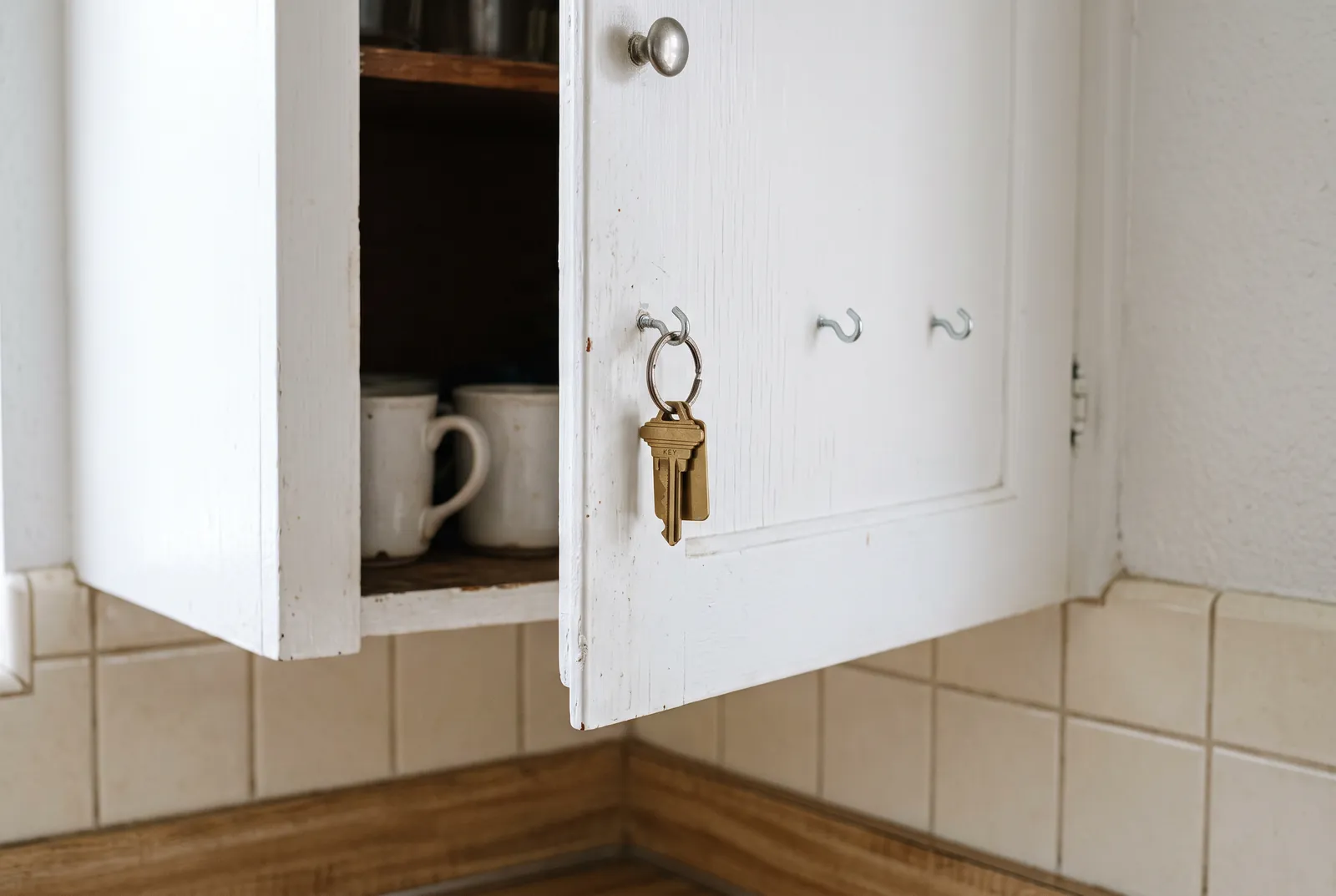
Why most spares are not spares
Nearly everyone says they have a spare. Standing on a step at twenty to five, most of those spares turn out to be one of three things: a key at a relative's house twenty minutes away, a key cut years ago that has never actually been tested, or a key inside the house that is locked.
None of those is a spare. A spare is a key you can hold within a few minutes at the hour you are most likely to need it, and which you know opens the door because you have tried it.
The test costs nothing. Take the spare, walk to the door, open the lock with it, and put it back where it lives. If it needs a wiggle or does not turn, it is a copy of a copy and it has drifted; a fresh cut from a good original is a few dollars and it is the cheapest thing in this article.
Where it should live
A neighbour on the same street is the best answer in this town, because it survives the hour. At half past five, somebody two doors down is more likely to be awake than a relative across the valley.
A lockbox on the property is the next best, if it is a decent one and it is not screwed to the fence beside the gate where anybody can spend an afternoon on it. Out of sight, on something solid, with a code you actually remember.
The worst answer is a hiding place. Under the mat, over the frame, in the fake rock: those are the first three places anybody looks, and everyone who has ever had a spare there believes theirs is the clever exception.
If you have none at all
Get one cut while a technician is already at your door. It takes a few minutes with the equipment out, costs a fraction of a separate visit, and it is the single most useful thing to ask for at the end of a lockout.
If the house is running on one key for three doors, that is the moment to rekey onto one blade at $25 to $41 per cylinder, because a single-key household is far easier to keep a working spare for than a three-key one.
And if the door only has a latch rather than a deadbolt, say so. On the newer builds the door from the garage into the house is often a passage latch, and a deadbolt in it is $112 to $279 — worth doing on the same visit while somebody with the tools is standing there.
Codes are spares too
A keypad is a spare that cannot be lost, which is its real advantage over an app or a fob. If you have one, the useful habit is changing the code when people stop coming rather than when something goes wrong: a contractor, a house sitter, a former neighbour who watered the plants.
Cells are the failure mode. They go flat on the coldest morning of the year, which in this valley is also the morning you are trying to leave at five. Change them on a schedule rather than when they stop, and keep a working keyway on the lock so a dead battery is an inconvenience rather than a lockout.
A keypad deadbolt fitted into the hole already in your door is $169 to $419, codes chosen by you and tested twice before anybody leaves.
Quick answers
Is a lockbox on the gate a bad idea?+
A cheap one in an obvious place is. A decent one, out of sight, on something solid, is a reasonable answer — and considerably better than a key under a mat. What matters is that it is not the first thing somebody sees when they walk up.
My spare needs a wiggle. Is that the lock or the key?+
Usually the key. A copy of a copy drifts from the original and eventually stops lifting the pins to the right heights. Cut a fresh one from your best key rather than from the worn spare, and test it on the door before you put it away.
Need it handled rather than read about?
(669) 356-8920