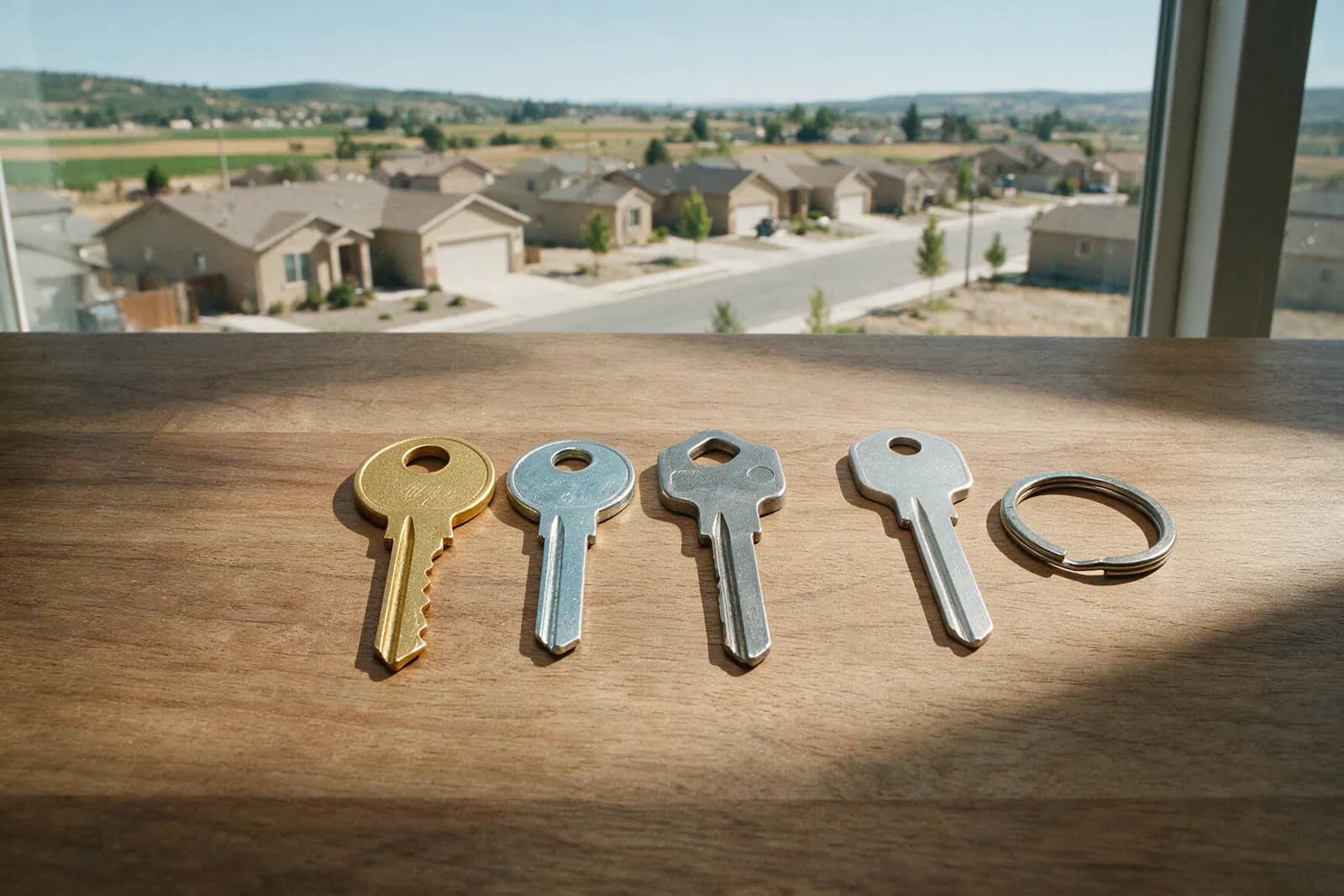
The ring in your pocket is a design problem
Count the keys you carry for your own property. On a house in town it is usually three: the front door, the garage service door and a gate or a shed. On an acre lot in San Martin or up at Eagle Ridge it can be seven or eight, once you add a barn, a shop, a pump house and a gate at the road.
Nobody chose that. The locks arrived at different times, from different owners and different builders, and each brought its own key. The result is a ring you sort through by feel, in the dark, at the hour when this town actually goes to work.
Rekeying fixes it without buying a single new lock. The lock stays on the door and takes a new set of pins, so it opens to a new key and stops opening to every key handed out before today.
What it costs and why it is cheap
It is $25 to $41 per cylinder, and the second and third sit at the low end because the van is already at your kerb. The $89 visit is counted once for the stop rather than once per lock, which is why doing four doors together costs far less than four separate visits.
Compare that to replacement at $112 to $279 per lock. If the hardware is sound, replacing it to get a new key is buying a solution to a problem you do not have. Rekeying is the cheaper answer nine times out of ten, and the only reason to replace instead is a lock that has actually failed.
Most padlocks can be brought onto the same key as the doors, which on a property with a gate and a couple of sheds is where most of the benefit is.
When to do it
When you buy. Every key handed through a builder, an agent and their trades still works until somebody changes the pins, and nobody can tell you how many exist.
When a crew or a tenant changes. On a working property this is the one that matters: twenty people were issued a key in March, and in November nobody is sure how many came back. If that is a recurring problem rather than a one-off, a reader on the doors that matter is worth pricing at $145 to $389, because a credential can be switched off in a minute and a key cannot.
And when you simply cannot account for the keys that exist. That is not paranoia, it is arithmetic, and it is the honest reason most people call.
The one limit worth knowing
A cylinder that has lived outdoors for twenty years cannot always be rekeyed usefully. Dust in the summer and damp in the winter wear the plug, and new pins in a worn plug give you a lock that turns badly with a different key instead of turning badly with the old one.
Where that is what is on your gate, you will hear it, with the replacement priced against the published $112 to $279 rather than folded in quietly. On a gate or a shed it is usually worth doing, because outdoor hardware is the part that strands people.
Two small habits are worth insisting on: take the retired keys back rather than letting them be carried off, and turn every rekeyed lock yourself before anything is signed. They cost nothing and they are what separates a job that is done from one that is merely over.
Quick answers
Can the padlock on my gate go on the house key?+
Most padlocks can, yes. On a property with a gate, a shop and a couple of sheds that is where the real gain is, because it ends the ring you sort through in the dark before a shift.
How long does it take?+
Three doors is usually under an hour. A country parcel with seven or eight locks is a morning. The $89 visit is counted once for the stop either way.
Need it handled rather than read about?
(669) 356-8920