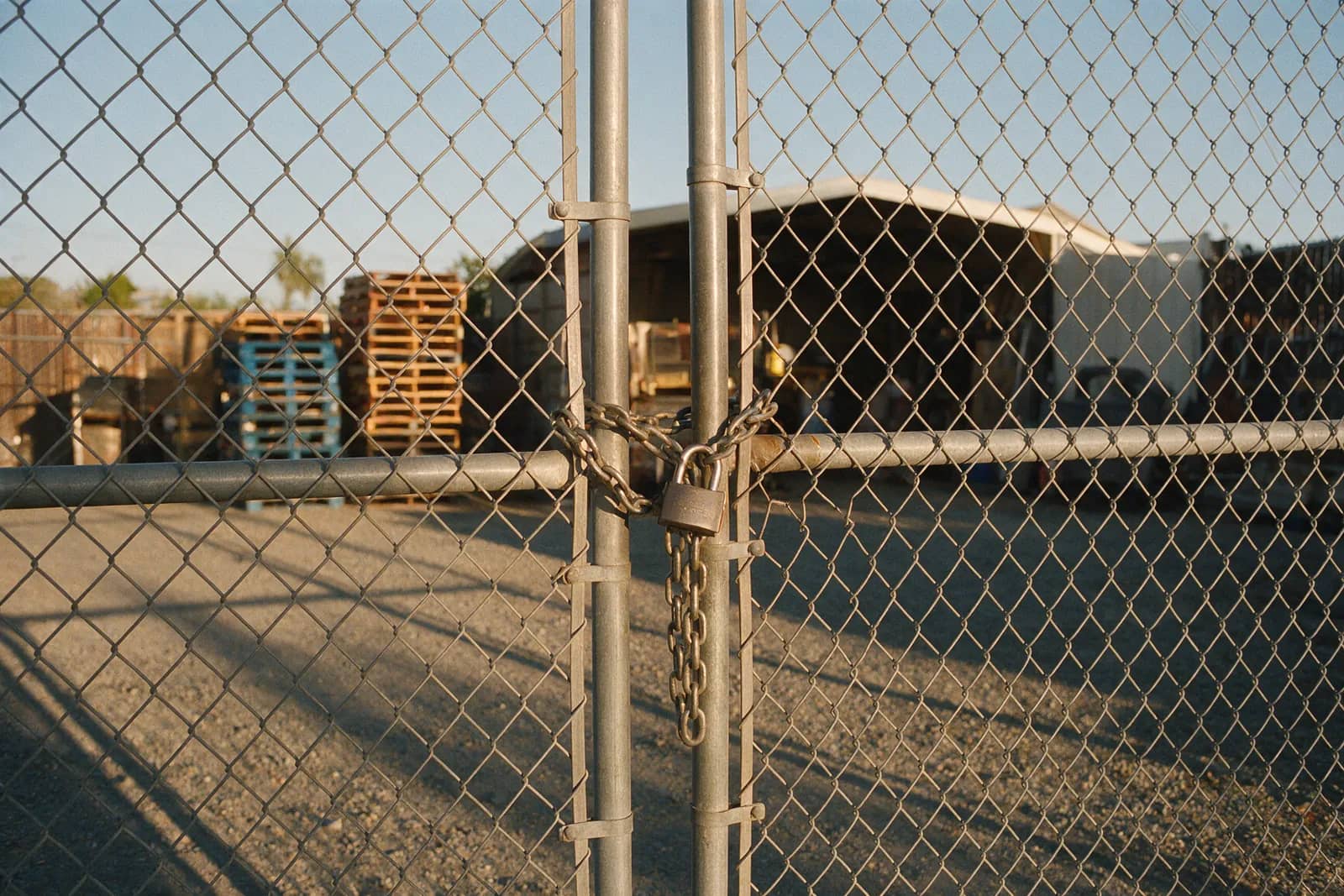
The November problem
On a working property here the arithmetic goes like this. In March, twenty people are issued a key to a gate, a shed or a cold store. In November, the season ends, and nobody can say with confidence how many of those keys came back.
That is not a comment on anybody's honesty. Keys get lost, left in a jacket, given to somebody who needed one on a Tuesday, or kept by somebody who assumed they would be back next season. It is a paperwork failure, not a moral one, and it repeats every year.
Which means the cost of metal keys on a seasonal site is not the cost of cutting them. It is the cost of rekeying every lock they opened, every autumn, forever.
When a rekey is enough
If the site is small — a gate, a shed and an office, three or four cylinders — rekeying once a year is genuinely the cheapest answer. It is $25 to $41 per cylinder with the second and third at the low end, and the $89 visit counted once for the stop.
Ask for keys to be stamped and issued against a list, even a handwritten one. That single habit turns next November from a guess into a count, and it costs nothing.
It is also worth deciding which doors genuinely need to be open to everybody. Very often a crew needs the yard gate and one shed, not the office and the chemical store, and splitting those is free at the point of rekeying.
When a master system pays
Once the site has several buildings and more than one level of access — a manager who opens everything, a crew leader who opens the yard and the sheds, workers who open one — a master key system stops being a luxury.
It is a hierarchy in metal: each key opens what its holder needs and nothing else, with a master above them. Designed properly it replaces a drawer of keys with one worth protecting. Designed carelessly it produces keys that open doors nobody intended, which is worse than no system.
It is never quoted on the phone. Every door gets walked and counted first, including which ones must stay outside the system entirely, and then it comes back as one figure. That walk-through does not commit you to anything.
When a reader is the honest answer
If the turnover is the problem rather than the layout, electronics win, and it is worth saying so plainly even though it is a different sale. A credential can be switched off in a minute; a metal key that did not come back means rekeying every lock it opened.
Access control on a staff door is $145 to $389 fitted, with credentials issued against a list. The sensible pattern on a working site is readers on the two or three doors where turnover actually bites, and ordinary keys on everything else — not readers on everything, which is how people end up spending three times what the problem was worth.
One condition worth insisting on: keep a mechanical override wherever the door allows. Power goes out and electronics fail, and a door with no key route in is a lockout waiting for the worst morning of the season.
Quick answers
Can the yard gates be on the same system as the buildings?+
Usually, and on a working yard that is where most of the value sits. One key for the gate, the shed and the office beats a crew leader carrying a ring in the dark at half past four.
We only have three locks. Is a system overkill?+
Yes. At that size, rekey once a year and issue keys against a list. A master system earns its keep when there are several buildings and more than one level of access, not before.
Need it handled rather than read about?
(669) 356-8920